

Payment Received
Claudias Cafe Savings Account
₦30,000.00
Designing and Launching Piggyvest Flagship B2B Payment Product
Piggyvest Business is the flagship B2B payment product of Piggyvest, designed to streamline financial operations for businesses of all sizes. As the lead product designer for this product, I was responsible for the end-to-end design and successful launch of the platform. The goal was to provide businesses with a seamless financial management tool tailored to their specific needs, including expense management, settlements, savings, and payments.
Understanding the problem
Managing a business involves multiple processes; tracking expenses, making and receive payments, saving, providing multiple channels for customer to make payments, invoicing clients, and receiving settlements etc. Before PiggyVest Business, many small and mid-sized businesses in Nigeria were relying on fragmented financial tools for this. Businesses used one bank for POS settlements, another for making expenses, another for receiving payments, another for saving and different tools for other financial operations. This disconnection leads to errors, delays, poor visibility into cash flow, and stunts business growth.
In addition, prior to Piggyvest business, we had a product called Patronise. It offered POS and digital payments, but users were asking us for more. We began receiving support tickets and feedback from merchants requesting more functionality beyond POS. A consistent narrative emerged;
Businesses wanted an all in one financial management tool that would help them simplify financial operations
Instead of building more features into an old foundation, we decided to rethink the entire experience. Not as a bank, Not as a savings tool. But as an operating system for money.
The challenge was addressing the fragmented financial workflows that most Nigerian businesses were managing across multiple platforms: invoicing, payments, transfers, expense tracking, savings, and more
Defining goals
Product Goals
- Simplify complex financial workflows
- Automate repetitive tasks
- Improve cashflow visibility
- Enable control, without sacrificing flexibility
Business Goals
- Drive adoption of PiggyVest’s Business as a financial services as opposed to what we previously had (Patronize)
- Increase savings retention from businesses
- Standout with an all-in-one offering
Design Goals
- Make complex features look simple
- Prioritize Action Over Navigation:The interface has to be task-oriented. Fewer steps, Faster results
- Build Trust Through Transparency: I designed every screen with errors and feedback in mind, so users always knew:
- What just happened
- What will happen next
- What went wrong, and how to fix it
Treat empty states, edge cases, validation, confirmation as core UX
Constraints
As the sole product designer working on this project, I owned design end-to-end. I had to do extensive personal research to understand the market I was building for, I also had to stay in constant alignment with the PM and engineers. This required setting up tight feedback loops, maintaining a design system in Figma, and making smart trade-offs that kept us moving fast without compromising quality.
One major constraint was balancing speed and quality. The team needed to launch quickly in response to business demand, but the product required thoughtful solutions for complex financial operations like bulk transfers, payment scheduling, and multi-account management. I adopted a lean design approach, prioritizing core features first and integrating edge case handling as we iterated. These design choices helped create a resilient and trustworthy financial tool without slowing down development.
Setting up the foundations
Before diving into screen flows and interactions, I laid the foundation of the design by establishing reusable design components and visual style to ensure scalability and consistency across the product

Designing the solution
1.Specialised accounts
We anchored the entire product around one simple idea: money needs mental containers. So every business on PiggyVest Business gets three default accounts
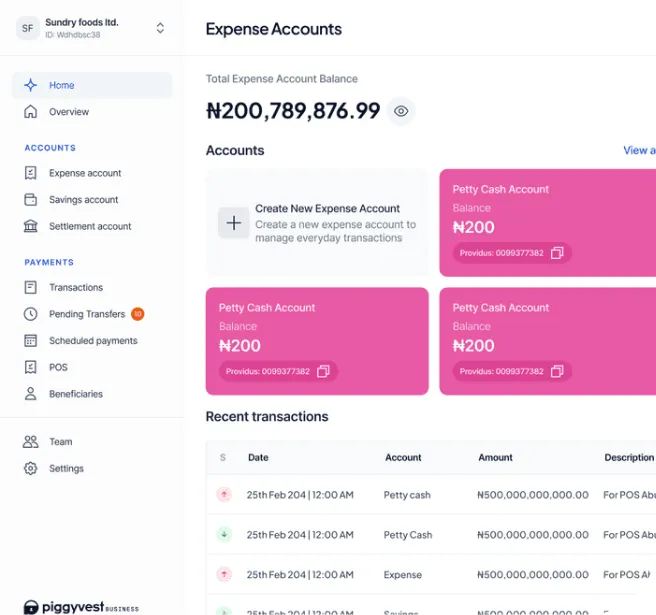
- Expense Account: For daily operations. Used to receive customer payments via POS or transfer, and make payments to suppliers or staff
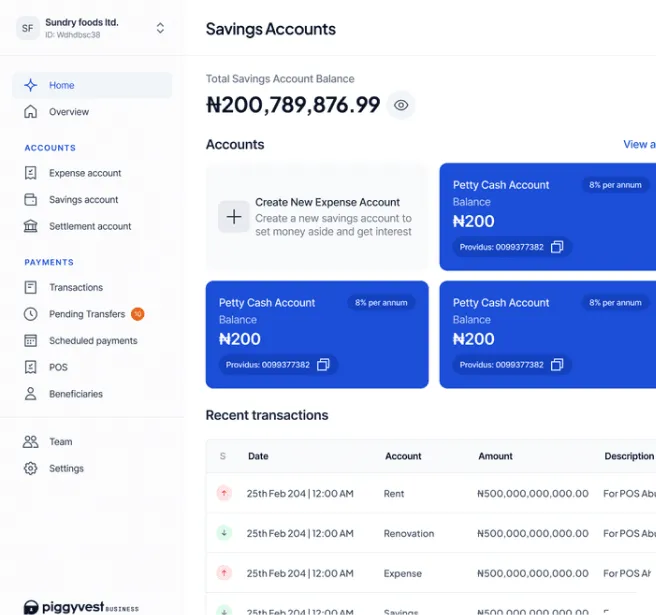
- Savings Account: Automatically earns 18% interest per annum. Allows businesses to plan for taxes, expansion, or emergencies.
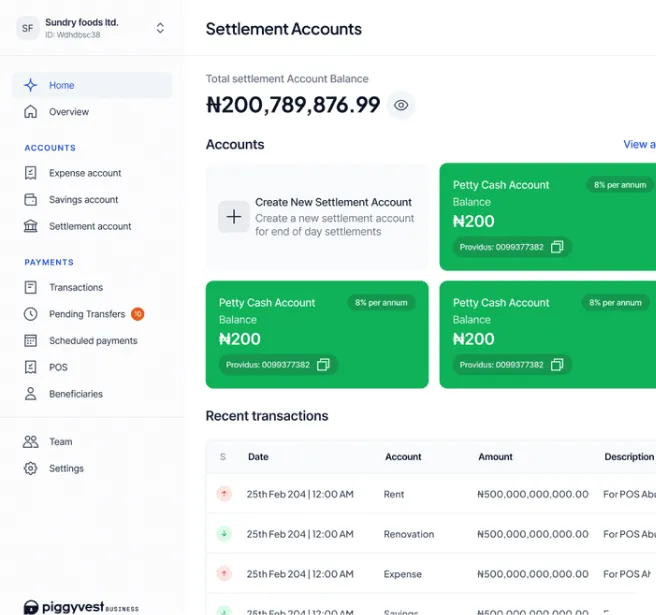
- Settlement Account: Dedicated to receiving POS settlements. Keeps operational revenue visible and separate from working capital.
Accounts can be created and personalised, Goals can be added, Funds can be moved instantly. But the structure gives clarity, from day one
Expense Account
Allocate funds for day to day company expenses.
Savings Accounts
To set aside business cash in a secure interest earning account
Settlement Accounts
To Receive settlements from Pos transactions


2.Scheduled one time and recurring payments
Instead of manually logging in daily or weekly to pay the same people, Businesses could:
- Set up recurring payments such as salaries, vendor payments, and subscriptions
- Schedule one-off future payments
This reduced manual interventions, errors and saved time, especially for businesses with regular payroll or supply payments.

3.Bulk transfer with CSV upload because sending money to 10 people should take 2 minutes not 20
For businesses needing to pay multiple they can
- Send multiple payments at once, eliminating the need for manual, one-by-one transactions.
- Upload a CSV with account numbers, amounts, and banks
- System validated all entries and flagged errors
- Users could fix issues inline or skip problematic rows
This Reduces processing time and improves efficiency in handling supplier and vendor payments.

4.Payment approvals and team access control
To reduce fraud and mistakes:
- Staff had role-based permissions (e.g., Manager, Ops, Super Admin)
- Transfers above a limit required approval from a higher role
- Users received push/email notifications when actions needed review


Results
Since Beta launch in November 2024
- Over ₦234M processed
- Launched PiggyVest Business as a new B2B product line
- Onboarded 100+ active businesses in the beta testing phase
- Reduced reliance on multiple external tools by consolidating financial workflows into one app
- Improved operational efficiency for businesses (faster payments, simpler reconciliation, clearer tracking of funds)
- Processed over 300BN In transaction volume in 2025